Showing posts with label justice. Show all posts

Tuesday, December 23, 2025

Two Lectures in Early 2026

What a great time I had with my last lecture series Pilgrims and Puritans: A Theocracy in Colonial New England.  And it seems the participants really liked the experience.  As one of them emailed me:

Thank you for another WONDER-FULL presentation. Of course, YOU would go above and beyond what the title implied. Pilgrims and Puritans ain't all turkey when Dincher is the one talkin'!

I am doing something a little different in early 2026.  I'll be delivering two single-session presentations through the Osher Lifelong Learning Institute at Cal State East Bay.

Beyond Economics: Healthcare Justice

Tuesday, March 3, 2026
9:30 AM to 11:30 AM
Register here

Medicine’s classical duty to “do no harm” has collided with a modern, market-driven healthcare system.  In today’s America, health care is no longer a simple exchange between doctor and patient. It’s a sprawling, high-stakes system involving providers, hospitals, clinics, labs, pharmaceuticals, cutting-edge technologies—and the ever-present insurance industry. The cost of accessing this system was the central flashpoint in the 43-day U.S. government shutdown of 2025.  But beyond economics lies a deeper concern: justice. When access to life-saving care depends on a person’s ability to pay, the problem becomes not only economic but ethical—a question of justice about who counts, who pays, and how a just society cares for the sick. Beyond Economics:  Healthcare Justice explores how values in medicine have evolved from Hippocrates’ timeless call to “do no harm” to today’s urgent debate over fairness and equity—and the intersections with theories of justice.

Erasing History—or Caring for our National Soul?

Tuesday, April 21, 2025
9:30 AM to 11:30 AM
Register here

Confederate statues topple from their pedestals. Military bases shed names that once honored rebellion. Government websites are scrubbed clean, museum exhibits closed, and school curricula rewritten.  Across the political divide, accusations fly—each side charging the other with “erasing history.” Yet beneath the noise lies a deeper question: when does such action distort the past, and when does it nurture the spirit of our nation? Erasing History—or Caring for the National Soul offers one perspective on the difference. 

Sunday, August 17, 2025

Truth, Justice, and Wednesday Addams

Have you seen this summer’s new Superman movie?  I haven’t.  I’ve been waiting for the kids to be back in school again before heading into the movie theater.  In the meanwhile, I have enjoyed the hype and the PR around the film.  I particularly enjoyed an interview on CBS Sunday Morning (6/29/2025) that TCM’s Ben Mankiewicz did with David Corenswet who plays the Man of Steel.  Throughout the interview, I wanted to hear what Mankiewicz would do with Superman’s tagline—and at the end of the interview, Mankiewicz finally said that the Superman would “fight for Truth, Justice and … well, you know the rest.”   

DC Comics created Superman in 1938—and then coined Truth, Justice and the American Way as Superman’s tagline during World War II to build morale in America’s fight against fascism abroad and at home.  Later, Truth, Justice and the American Way became engraved on America’s cultural consciousness with Adventures of Superman, the TV series that aired from 1952 until 1958 in the early days of the Cold War.  Since I was only three years old when the series ended in 1958, my childhood memories of the show must be from when it was later syndicated to local channels.  In any event Truth, Justice and the American Way has endured through the many iterations of Superman and his compatriots since.  Well, at least until recently.


George Reeves as Superman

In 2021, DC Comics changed Superman’s tagline.  Going forward, the Man of Steel would fight for Truth, Justice and A Better Tomorrow rather than for the American Way. 

Superman’s new motto of “Truth, Justice and a Better Tomorrow” will better reflect the global storylines that we are telling across DC and to honor the character’s incredible legacy of over 80 years of building a better world.  … Superman has long been a symbol of hope who inspires people from around the world, and it is that optimism and hope that powers him forward with this new mission statement.

 Jim Lee, President, Publisher, and Chief Creative Officer of DC Comics

Superman’s New Motto Revealed at DC FanDome

October 16, 2021

Despite Lee’s positive spin on the change from the American Way to a Better Tomorrow, I wonder if the people at DC Comics were aware that the United States was moving to a place where the American Way would lose some of its cachet in the international market.  Were they aware of the irony of using a tagline with anti-fascist origins when Americans were about to go all in on our own fascist dictatorship?   

I became aware of the change to Superman’s motto earlier this year when I was exploring ideas for a new lecture series in the lifelong learning program that I occasionally teach in.  Although I eventually decided on Pilgrims and Puritans:  A Theocracy in Colonial New England, I considered a series on various philosophical approaches to truth and justice, using the Superman’s new tagline Truth, Justice and a Better Tomorrow as the title of the series.  I ran the idea by a long-time Jesuit friend, and he suggested an edit to the title:  Truth, Justice and the Hope of a Better Tomorrow.

I didn’t initially like Joe’s suggestion.  Hope has always struck me as a tremendously passive virtue in the style of Little Orphan Annie cockeyed optimism:

Oh! 

The sun'll come out

 Tomorrow 

 So ya gotta hang on 

 'Til tomorrow 

 Come what may! 

I tend to think that most of us are already passive enough without people telling us we should just hang in there, grin and bear it, and eventually everything will get better—that someday, somehow, someone will fix whatever mess we find ourselves in.       

I am not an optimist by nature.  I do not spontaneously anticipate positive outcomes.  As the gloomy Wednesday Addams tells her perky friend Enid Sinclair in the Netflix series Wednesday, I can be the dark cloud for your silver lining.  I am likely thinking that the odds are that the sun will not come out tomorrow and that we are headed to hell in a handbasket—and increasingly so as I watch the current blitzkrieg against our democratic principles, norms, and values:  the growing abuse of power, the increasing censorship, the demonization of minorities and the vulnerable, and the transfer of wealth to the ultra-rich.  No, Candide, this is not the best of all possible worlds.


Jenna Ortega as Wednesday Addams
(with Victor Dorobantu as Thing)


Wednesday Addams is my new role model.  She embraces her innate pessimism and yet is actively and courageously hopeful.  She speaks truth to power.  She defends the weak against their oppressors.  And she fights for her community against those who oppose its principles and values and would destroy it.  Wednesday fights for truth, justice, and a better tomorrow!  And that is the real essence of hope.  Not expecting things to work themselves out. Not anticipating that someone else will do something.  But believing we can do something ourselves to create some good—and then doing it.

Hope is actualized only in action.  Hope does not allow us to sit on the sidelines.   As Maria von Trapp sings in the Sound of Music, “nothing comes from nothing, nothing ever could.”  And that means that courage is an essential element of hope. Fighting for truth, justice and a better tomorrow involves taking risks and persevering through doubts and difficulties.  Fighting for truth, justice and a better tomorrow requires us to act against powerful forces and with uncertain outcomes.  

Our political institutions with their system of checks and balances have become impotent against the overwhelming assault on constitutional republic.  Our hope lives in our own actions.  In resistance and dissent.  In protest.  Perhaps even in civil disobedience.  Ask yourself what you are willing to commit to hope for.  And then do it.  Wage hope!


Monday, July 14, 2025

Meeting Lady Justice in Switzerland

June was a busy month for me—and enjoyably included a 12-day trip to Switzerland with its awe-inspiring natural beauty and its exceptionally friendly and welcoming people.  I visited Switzerland once before, but that was over 45 years ago.  Therefore, this was a trip that both revived old memories and add new experiences. 

When visiting a place again after many years, however, the “new experiences” are not necessarily because the place has changed, but because you have.  If you have grown at all over that time, then you have learned.  Your knowledge and interests have expanded, and your appreciation for things has broadened.  Your way of seeing changes.  As a 25-year-old, I was impressed by Marc Chagall’s windows in Zürich’s Fraumünster; about to turn 70, my experience of the windows was less intellectual, more contemplative.

Another Swiss church that engaged me was the Swiss Reformed cathedral (or minster) in Bern.  I was captivated by the main portal which is said to be one of the most complete Late Gothic sculpture collections in Europe. This collection represents the Last Judgment when the wicked will be separated from the righteous.  Depicting the Last Judgement over the main portal of Gothic cathedrals was commonplace, intended to inspire awe and piety in the faithful as visual reminder of the ultimate judgment and its consequences.  Usually, the Last Judgment displays Jesus Christ enthroned in majesty and Michael the Archangel weighing souls, sending the righteous to their reward and the wicked to their punishment.  The west portal of Notre Dame in Paris features such a Last Judgment tympanum.   The west portal of Bourges Cathedral, another typical example, also features the Last Judgment with Michael weighing souls.

The main portal of Bern’s Minster is remarkable in part because it survived the church’s transformation from a Catholic church to a Protestant one during the Reformation when the paintings and sculptures from inside the church were all destroyed.   But the Last Judgement depiction is also remarkable for one of its atypical details.  As usual Jesus Christ is enthroned in majesty and overseeing the judgement.  Michael the Archangel is also present; however, he stands below the action and is not involved in weighing the souls.  Instead standing between the righteous and the wicked and conducting the separation is a woman holding a sword and scales.  The woman is Lady Justice—also known as Justitia.  The obvious symbolism is that justice is being served in rewarding the righteous and damning the wicked. 

But Justitia appropriating Michael’s role also suggests that justice is the delineator between righteousness and wickedness. 

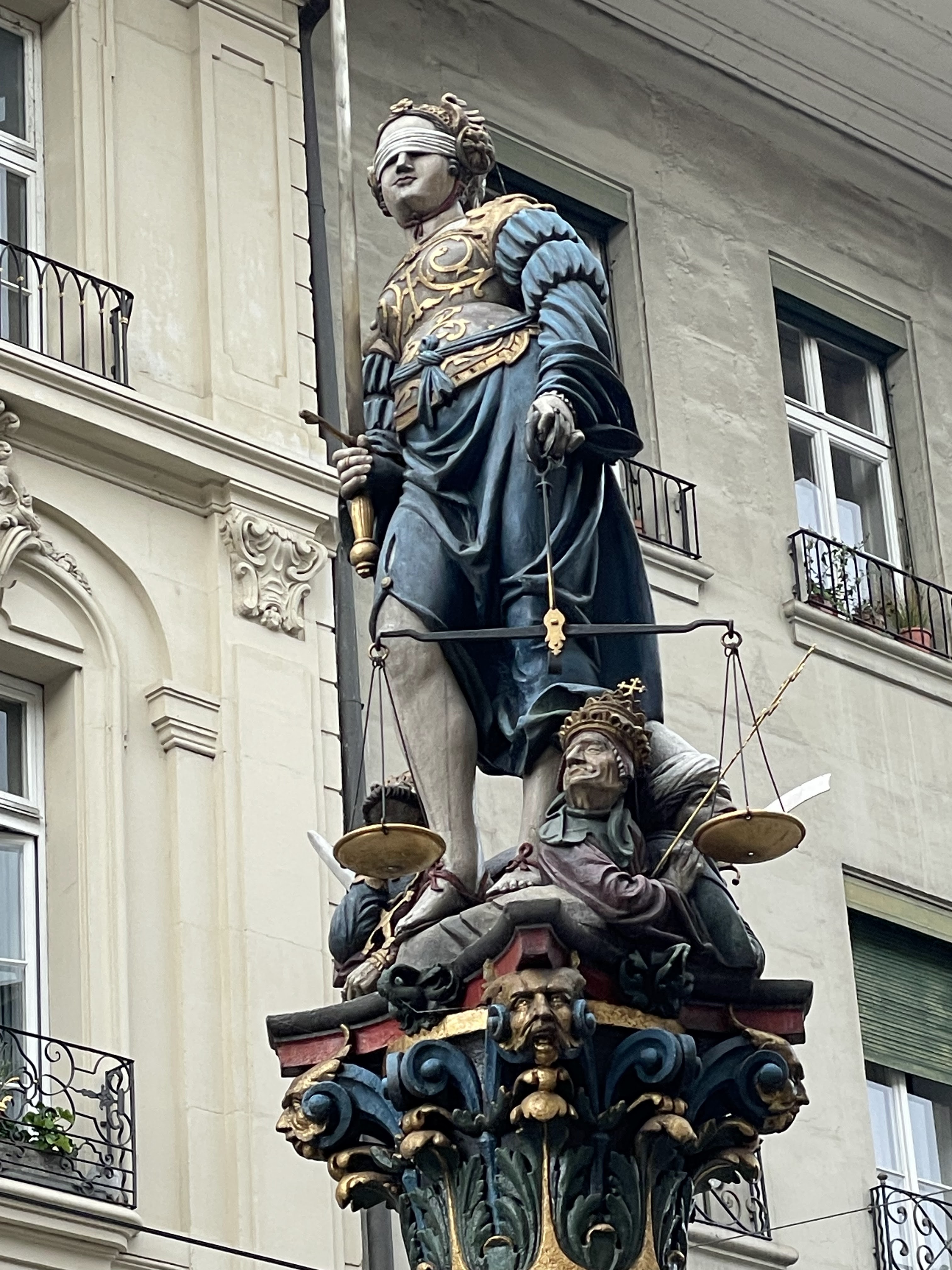
A short walk from the Bern Minster is another representation of Lady Justice:  Hans Gieng's 1543
Gerechtigkeitsbrunnen—Fountain of Justice.   Atop the fountain, Justitia stands with her traditional attributes:  the sword of justice in her right hand and a balance in her left hand.  Unlike the statue on the minster, however, Gieng’s Justitia is blindfolded.  The blindfold was an innovation and thought to be the first such representation of Lady Justice.  Only later did the blindfold became commonplace. Associated with the positive ideal of impartiality, fairness, and equality before the law, the blindfold implies that true justice is done without consideration of a person’s rank, power, wealth, or social standing.


Associated with the ideal of impartiality, fairness, and equality before the law, the blindfold implies that true justice is done without consideration of a person's rank, power, wealth, or social standing.

In addition to his innovative blindfold, Gieng placed the heads of four power figures at Lady Justice’s feet:  a pope, an emperor, a sultan, and a Schultheiss (the head of a municipality akin to a mayor).  They represent the four forms of government according to the Renaissance humanism of the time:  theocracy (the pope), monarchy (the emperor), autocracy (the sultan) and the republic (the Schultheiss).    The four figures all have their eyes closed—generally interpreted as an act of submission to Justitia.   

In other words, justice trumps power. 


What Happens When God is Dead?

When Friedrich Nietzsche declared that “God is dead,” he was not simply making an argument against belief. He was diagnosing a cultural cris...