Monday, February 1, 2021

America's Gilded Age: An Era of Contradictions

Following the American Civil War, the nation experienced rapid economic expansion, inaugurating what became known as The Gilded Age—a glittering era in which a gilding of economic growth masked growing problems   Perhaps nothing symbolized the era’s contradictions more than the RMS Titanic—with its opulent first-class accommodations overshadowing the 700-plus steerage passengers who had access to only two bathtubs and slept in bunk beds without sheets or pillowcases.

 The contradictions of the era extended well beyond the combination of growing wealth and growing poverty.  Ostentation and flamboyant excess co-existed with the Golden Age of Philanthropy.  Farmland grew with wealthy suburbs while cities descended into poverty.  Industrialists battled conservationists and labor unions.  Manufacturers fueled immigration to their staff factories while nativists fought to close the borders.  Corrupt political machines took control of urban politics and widespread social activism and political reform spread across the United States.

Let’s explore the contradictory trends and impulses of the era – and see if they tell us about ourselves and our society today!


America's Gilded Age:  An Era of Contradictions

My Online Lecture Series via Zoom

Osher Lifelong Learning Institute @ California State University - East Bay

5 Wednesdays, June 16 – July 14, 2021
10:30 AM to 12:30 PM


Potential Lecture Topics

  • America After the Civil War:  An Impoverished South while the North and the West Boomed
  • Technology and Industrialization
    • The Gilded Age and its Robber Barons
    • The Battle between Industrialization and Conservation
    • The Labor Movement
  • Social Issues
    • Urbanization and the Decline of American Cities
    • Racism, Nativism and Populism
    • Women’s Suffrage
  • Political Corruption and Progressive Reform
  • The End of the Era:  The Titanic and World War I

Food for Thought

A young Mark Twain (about 1850)
Mark Twain and Charles Dudley Warner:  The Gilded Age: A Tale of Today  
  • A satire of greed and political corruption in post-Civil War America

Hugh Brewster:  Gilded Lives, Fatal Voyage: The Titanic's First-Class Passengers and Their World 

  • Interweaves personal narratives of the lost liner’s Gilded Age people with a haunting account of the fateful maiden crossing

Kathleen Waters Sanders:  Mary Elizabeth Garrett: Society and Philanthropy in the Gilded Age 

  • Examines the great social and political movements of the age through the life of one of the most influential philanthropists and women activists of the Gilded Age

Douglas Brinkley:  The Wilderness Warrior: Theodore Roosevelt and the Crusade for America 

  • Draws on never-before-published materials to examine the life and achievements of our “naturalist president”

Timothy Egan:  The Big Burn: Teddy Roosevelt and the Fire That Saved America 

  • About the Great Fire of 1910, which burned about three million acres and helped shape the United States Forest Service - while describing some of the political issues facing Theodore Roosevelt's conservation efforts

Erik Larson:  The Devil in the White City: Murder, Magic, and Madness at the Fair That Changed America  

  • While telling the story of the 1893 World's Columbian Exposition in Chicago and the story of H. H. Holmes, a criminal figure in that same time often credited as the first modern serial killer, Larson also describes the condition of America’s cities at the end of the 19th century

David Von Drehle:  Triangle:  The Fire that Changed America­

  • The story of one of America’s most deadly industrial disasters with an emphasis on the humanity of the victims and the theme of social justice

Upton Sinclair:  The Jungle  

  • The living and working conditions of immigrants in America’ Gilded Age

Daniel Okrent:  The Guarded Gate:  Bigotry, Eugenics and the Law that Kept Two Generations of Jews, Italians and Other European Immigrants Out of America

  • The history behind the eneactment of the 1924 Johnson-Reed Immigration Act which severly limited immigration to the United States.  


Thursday, October 24, 2019

The Dirty 30s: The Dust Bowl - an Environmental Disaster in America's Heartland

Osher Lifelong Learning Institute
California State Univerity, East Bay - Concord Campus

Tuesday, January 28, 2020 - 10:30 AM to 3:30 PM
Stoneridge Creek - 3300 Stoneridge Creek Way, Pleasanton, CA

Wednesday, January 29, 2020 - 10:30 AM to 3:30 PM
CSU-East Bay, Concord, Campus - 4700 Ignacio Valley Road, Concord, CA


America's Gilded Age (1870-1900) was a time of enormous growth made possible by the nation's vast natural resources and post Civil War industrialization.  The U.S. rapidly expanded its economy into new areas (especially heavy industries like railroads, factories and mining) which attracted 10 million immigrants from Europe - creating a huge demand for food and other resources as the population of towns and cities exploded.


As the 19th century gave way to the 20th and Teddy Roosevelt was preaching conservation from the White House, farmers on America's Great Plains were transforming one of the world's largest ecosystems into the world's most productive farmland.  But as American busness and cities industrialized, so did the farmers in America's mid-section - and the Great Plow-up created the environmental disaster known as the Great American Dust Bowl which gave the 1930s the nickname "The Dirty 30s."

100 million acres of U.S. farmland became useless.  Immense dust storms called "black blizzards" and "black rollers" bured Chicago, halted traffic in New York City, deposited dust on the President's deck in Washington, and even blanketed ships in the mid-Atlantic.  By the mid-1930s, dust pneumonia was rampant.  Doctors found their patients literally stuffed with dirt.  The Red Cross declared a medical crisis in 1935 and opened 6 emergency hospitals in Colorado, Texas and Kansas, some in school gyms that had to be specially sealed to protect patients from incoming dust storms.

Over a million people fled, becoming environmental refugees.  Many headed to California with its promise of good weather and work.  Overall 25% of the population of the area designated as the Dust Bowl abandoned their homes.  Some counties lost as much as 50% of their population.   Approximately 15% of the population of Oklahoma migrated to California - accompanied by many others from neighboring states as well as people from further east seeking relief from the Great Depression.

Lecture Topics

  • Driven West:  Manifest Destiny and Settling the Great Plains
  • The Progressive Era:  From Gilded Age Industrialization to Conservation
  • The Great Plow-up:  The Economic and Environmental Crisis
  • Okie Migration:  Environmental Refugees of the Great Depression


Food for Thought

  • The Worst Hard Time:  The Untold Story of Those who Survived the Great American Dust Bowl (Timothy Egan)
  • The Big Burn:  Teddy Roosevelt and the Fire that Saved America (Timothy Egan)
  • The Dust Bowl:  An Illustrated History (Dayton Duncan and Ken Burns)
  • The Dust Bowl Through the Lens:  How Photography Revealed and Helped Remedy a National Disaster (Martin W. Sandler)
Migrant Mother
by Dorothea Lange
Related Novels
  • The Grapes of Wrath (John Steinbeck)
  • Of Mice and Men (John Steinbeck)
  • Cimarron (Edna Ferber - the 1889 and 1893 Oklahoma Land Runs)
  • Mary Coin (Marisa Silver - inspired by Dorothea Lange's iconic photo Migrant Mother)
  • Whose Names are Unknown (Sanora Babb)
Videos/Movies
  • The Dust Bowl (Ken Burns)
  • Surviving the Dust Bowl (American Experience:  The 1930s, Episode 4)
  • Cimarron (1931 and 1960 adaptions of Ferber's novel)
  • Far and Away (directed by Ron Howard, portrays the Cherokee Strip Land Run of 1893)
  • The National Parks:  America's Best Idea (Ken Burns and Dayton Duncan)


  • What I'm Reading: October, 2019

    October.  The month when Americans observe Columbus Day.  Or Indigenous Peoples' Day.  Or both.  Or neither.s  There's plenty of controversy over Columbus' legacy and what we should be observing on the second Monday of October—controversy that is not easily contained in either our national mythology or general history courses about European mass immigration to the North American continent which was already peopled by somewhere between 8 million and 115 million.

    This month there are two books on the docket:  Mayflower which I’ve finished and The Barbarous Years which I am still in the middle of.

    Mayflower:  A Story of Courage, Community, and War (2006) by Nathaniel Philbrick

    Philbrick tackles the truth behind about the voyage of the Mayflower and the settlement of Plymouth Colony with its challenging first winter for which the settler were utterly unprepared.  After initial attempts between indigenous Wampanoag people and the English to co-exist peacefully, relations collapse, culminating in King Philip’s War (1675–1678) which nearly wiped out both English colonists and Native Americans.  Plymouth Colony lost close to 8% of its adult male population (and a smaller percentage of women and children) and many towns were burnt down and destroyed -  while the Native American population of southern New England was reduced by somewhere between 60% to 80%.  Philbrick’s final chapter section, "Conscience," attempts to examine the conflict from an ethical perspective and grapple with its legacy for United States history.


    The Barbarous Years: The Peopling of British North America—The Conflict of Civilizations, 1600-1675 (2013) by Bernard Bailyn

    I am still in the middle of The Barbarous Years, and to be honest it is a difficult readBailyn could benefit from a good editor.  As one reader commented:  the auhor definitely does not hold back on naming thousands of settlers across the colonies; it is difficult to slog through all of that.  The book does seem a littler scattershot in its organization and subject matter.

    The Barbarous Years is not an easy read.  But I’m learning a lot, and the more-than-occasional awkward sentence structure and tendency to be over-detailed has been worth putting up with so far. Examining Virginia, the Chesapeake area, New York, and New England, Bailyn makes no effort to sugarcoat the Europeans’ experience in America in the 17th century and their relationships with Native Americans.  About halfway through, it has been a less-than-flattering picture of the early leaders and settlers.
     

    Thursday, May 23, 2019

    What I'm Reading: May, 2019


    The Guarded Gate: Bigotry, Eugenics and the Law That Kept Two Generations of Jews, Italians, and Other European Immigrants Out of America 

    The Guarded Gate: Bigotry, Eugenics and the Law That Kept Two Generations of Jews, Italians, and Other European Immigrants Out of America by [Okrent, Daniel]
    On May 24, 1924, U.S. President Calvin Coolidge signed into law the Immigration Act of 1924 after the legislation sailed through both houses of Congress.  The Immigration Act of 1924 was not the first legislative effort to limit immigration—the nation passed it first immigration law in 1875—but the 1924 law was more extreme than anything that preceded it.

    The 1924 law banned all immigration from Asia.  It also limited the total annual number of immigrants from outside the Western Hemisphere to 165,000–a number less than half the 357,803 people who entered the US in 1923.  165,000 was an 80% reduction from the pre-World War I average and far below the peak year of European immigration of 1907 when 1,285,349 persons entered the country.  The impact of the law was immediate:  in 1923, an average of 20 ships a day docked at Ellis Island where 70% of immigrants entered the U.S.; in 1924 that number dropped to 2.

    But the 1924 legislation was not about numbers.  Arguments in favor of previous immigration legislation focused on employment and economic numbers; but the arguments for the 1924 legislation were biological. 

    In the first decades of the 20th century the pseudoscience of eugenics, imported from England, swept through the United States becoming a staple of the nation’s most eminent academic and scientific institutions—and of the nation’s political agenda of both progressives and reactionary activists.  The basic premise of eugenics is that some races of inherently superior to others.  Eugenics promised Americans that selective breeding and controlled socialization would rapidly result in the development of a superior American race—and warned that mingling with “inferior races” would not only slow down that development but would cause Americans to join the ranks of what eugenicists referred to as the mongrel races. 

    The word race in the early 20th century was used different from contemporary usage.  If you look at the census records from that period, you will see entries like English, German, Italian and Polish for race.  And the “racial” make-up of immigrants coming to the United States prior to the 1924 law had become predominantly Italian, Greek, Polish, Eastern European and Jewish—all deemed inferior races by American eugenicist.  American researchers “proved” their inferiority and the danger they posed to American racial development and society with faulty and culturally-biased IQ tests that asked them questions about obscure American baseball players and abstruse facts of American history that the descendants of Mayflower passengers would not know. 

    Legislators knew, however, that the cap on total immigration and the ban on Asian immigrants were not sufficient to ensure that so-called superior races entered the country.  Therefore, the 1924 law also set country quotas for immigrants from Europe.

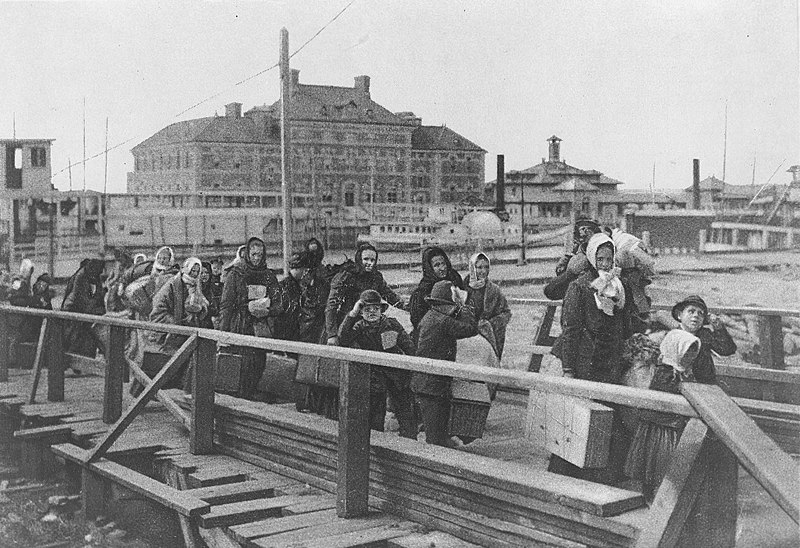
    Immigrants arriving at Ellis Island, 1902
    (Library of Congress)
    Quotas has been implemented before.  The Emergency Quota Act, also known as the Emergency Immigration Act of 1921 (enacted to stem the influx of Jews fleeing persecution in Eastern Europe) restricted the number of immigrants admitted from any country annually to 3% of the number of residents from that same country living in the United States as of the U.S. Census of 1910 (although professionals were to be admitted without regard to their country of origin).  This meant that Northern European countries had a higher quota and were more likely to be admitted to the U.S. than people from Eastern Europe.

    The 1924 law changed the quota formula to 2% of the number of residents from that same country living in the United States as of the U.S. Census of 1890.   Immigration from every European country declined.  German, English and Irish immigration declined by about 19%.  The greatest impact, however, was on the “inferior races” from Southern and Eastern Europe who had not immigrated to the U.S. in any significant numbers before 1890.    Immigration from Italy, for instance, dropped by about 90%.  Before 1924, 70% of immigrants to the U.S. were people from Southern and Eastern Europe.  The Immigration Act's quotas lowered that to 11%.
     
    Eugenics gave respectability to America’s uneasy relationship with the words of Emma Lazarus carved on the base of the Statue of Liberty—and the Immigration Act of 1924 was designed, and as Henry Curran, the Commission of Immigration for the Port of New York stated in 1925, to ensure that future newcomers would be the kind we would be glad to welcome.  In 1925 Curran wrote: 

    Today there is not one immigrant in a thousand who does not dress, walk, and generally look so much like an American that you will believe they are all really Americans  (The New Immigrant).

    In 1929, on the eve of the refugee crisis created by the Nazi rise to power in Germany, U.S. immigration quotas were adjusted—downward.  The quota formula was changed to one-sixth of 1% of the 1920 census figures with the overall immigration limit reduced to 150,000.  The law contained no provisions for refugees, and the U.S. refused to modify the law to aid the flight of Jewish refugees from Nazi Germany in the 1930s and 1940s.  

    The only significant attempt to pass a law to aid refugees came in 1939.  Democratic Senator Robert Wagner of New York and Republican Congresswoman Edith Rogers of Massachusetts introduced legislation  that would allow 20,000 German refugee children under the age of 14 into the United States over two years outside of the immigration quotas. The legislation never made it out of committee for a vote.   

      Thursday, March 7, 2019

      What I'm Reading: March 2019


      March is Women's History Month, commemorating and encouraging the study, observance and celebration of the vital role of women in American history - and March 8th is International Women's Day.  

      Therefore, I have a book by Cokie Roberts on the docket for this month. 


      Capital Dames: The Civil War and the Women of Washington, 1848-1868

      When the Civil War began, Washington, D.C. was a small Southern town that was quickly transformed into an immense Union army camp and later a hospita.  Many Southern women chose to leave the city for safer (and more sanitary locations.
      But many women stayed and joined the Union cause.  And many women moved to Washington to work as nurses, supply organizers, relief workers and journalists - and also as munitions workers in highly flammable arsenals.  Somoe put their sewing skills into service at The Navy Yard - which was traditionally "Men Only" - to sew vancas gundpowder bags for the troops.

      Cokie Roberts tells the stories of these women and their increasing independence, their political empowerment, and their indispensible role in keeing the Union unified through the war.  The war not only changed Washington; it also changed the place of women in America.

      Also by Cokie Roberts and worth reading:
      • Founding Mothers:  The Women Who Raised Our Nation
      • Ladies of Liverty:  The Women Who Shaped our Nation  
       

      Four Roads in the Garden of Beasts: Appeasement, Collaboration, Resistance and Dissent in Nazi Germany


      In August 2019 I will be presenting my lecture 

      Four Roads in the Garden of Beasts:  Appeasement, Collaboration, Resistance and Dissent  in Nazi Germany

      through the CSU-East Bay Osher Lifelong Learning Institute (OLLI) in the San Francisco Bay Area.


      In the Garden of Beasts is Eric Larson’s 2011 book about U.S. Ambassador William Dodd and his family’s time in Germany from 1933 to 1937.  The Garden of Beasts is a loose translation of the Tiergarden, Berlin’s version of Central Park, around which much of the political and diplomatic action of Larson’s book takes place – and is, of course, a metaphor for the general state of Germany in the 1930s and 1940s. 

      U.S. Ambassador William Dodd and his family
      arriving in Hamburg in July 1933

      When the Dodds arrived in Germany, storm troopers were beating American tourists on the streets and Jews were increasingly the target of brutal violence and tightening social restrictions.  Dodd arrived in Berlin holding the Antisemitic notions typical of America at the time—expressed rather simply by his daughter, Martha (who unbeknownst to her father was a Soviet spy), “We sort of don’t like the Jews anyway.”  But first-hand experience of the Nazis convinced Dodd they were an increasing threat, and he resigned in protest over his inability to mobilize the Roosevelt administration, particularly the State Department, to counter the Nazis prior to World War II.

      But how did others in Germany and abroad respond to the Garden of the Beasts?  They took one of the 4 roads:  appeasement, collaboration, resistance and dissent.  This lecture will take a short drive down each of those roads.

      Food for Thought


      Fascism 101:  We will take a very brief look at Fascism and the social, economic and political conditions in Germany at the time of Hitler’s rise to power. 
      In the Garden of Beasts:  Love, Terror and an American Family in Hitler’s Berlin (Eric Larson)
      Fascism:  A Warning (Madeleine Albright)
      The Long Night:  William L. Shirer and the Rise and Fall of the Third Reich (Steve Wick)
      The Rise and Fall of the Third Reich (William L. Shirer)

      Appeasement:  In an international context, appeasement is the diplomatic policy of making concessions to an aggressive power in order to avoid conflict – and is most often applied to the foreign policy of the British governments of Prime Ministers Ramsay MacDonald, Stanley Baldwin and Neville Chamberlain towards Nazi Germany and Fascist Italy.  But others – including the leaders of the Weimar Republic and political leaders in the USA—chose the path of appeasement in dealing with Hitler. 
       The Death of Democracy:  Hitler’s Rise to Power and the Downfall of the Weimar Republic (Benjamin Carter Hett)

      Collaboration:  Collaboration is defined as cooperation between elements of the population of a defeated state and representatives of the victorious power.  Within nations occupied by the Axis Powers in World War II, some citizens and organizations knowingly collaborated with the Axis Powers. 
      Sarah’sKey (Tatiana de Rosnay)
      The Vél d'Hiv Raid: The French Police at the Service of the Gestapo (Maurice Rajsfus)

      Resistance:  Resistance movements were rare in Germany, but during World War II occurred in every occupied country by a variety of means ranging from non-cooperation, disinformation and propaganda to hiding crashed pilots and hiding Jews and to outright warfare and the recapturing to towns.  In many countries, resistance movements were referred to as The Underground. 
      Sophie Scholl:  The Real Story of a Woman who Defied Hitler (Frank McDonough)
      Outwitting the Gestapo (Luci Aubrac)

      Dissent:  Although it usually resulted in imprisonment or death, publicly expressing non-agreement or opposition to the philosophy and actions of the Nazi regime did occur - particularly among the dissenting religious leaders like pastor and theologian Dietrich Bonhoeffer and Cardinal Clemens August Graf von Galen.
      Dietrich Bonhoeffer:  Pastor, Martyr, Prophet, Spy (Eric Metaxes)

      Tuesday, February 5, 2019

      What I'm Reading: February 2019


      My February Tradition

      Because January ends with the United Nations designated International Holocaust Remembrance Day on the 27th, every year I slip into February reading something related.  But February is Black History Month, and so I always include a work on the lives or history of African-Americans.

      The Inextimguishable Symphony:  A True Story of Music and Love in Nazi Germany by Martin Goldsmith

      • Martin Goldsmith, director classical music probramming for XM Sattelite Radio in Washington, D.C. and former host of National Public Radio's Performance Today, tells the story of his musician parents and their participation in the Jewish cultural association maintained by the Nazis for propagansa purposes.  Goldsmith is also the author of Alex's Wake:  A Voyage of Betrayal and a Journey of Remembrance, the story of his grandfather's journey with more than 900 other Jewish refugees fleeing Nazi Germany aboard the St. Louis.  Turned away from Cuba, the United States and Canada, the St. Louis returned to Germany where the refugers were caught in Nazi roundups of Jews in occupied countries.
      Ida:  A Sword among Lions by Paula Gidding

      Ida B. Wells
      • Ida B. Wells (1862-1931), born a slave in Mississippi, began her activist career by refusing to leave a first-class ladies' car on a Memphis railway and rose to lead the nation's first campaign against lynching.  An investigative journalist, educator, and early leader in the Civil Rights Movememnt, she was on of the founders of the NAACP.  She became the most famous Black woman in America during a life that was centered on combating prejudice and violence.


      Orwell's War on Sloppy Language

      When George Orwell sat down in 1946 to write Politics and the English Language , he wasn’t just irritated by bad prose. He felt something la...